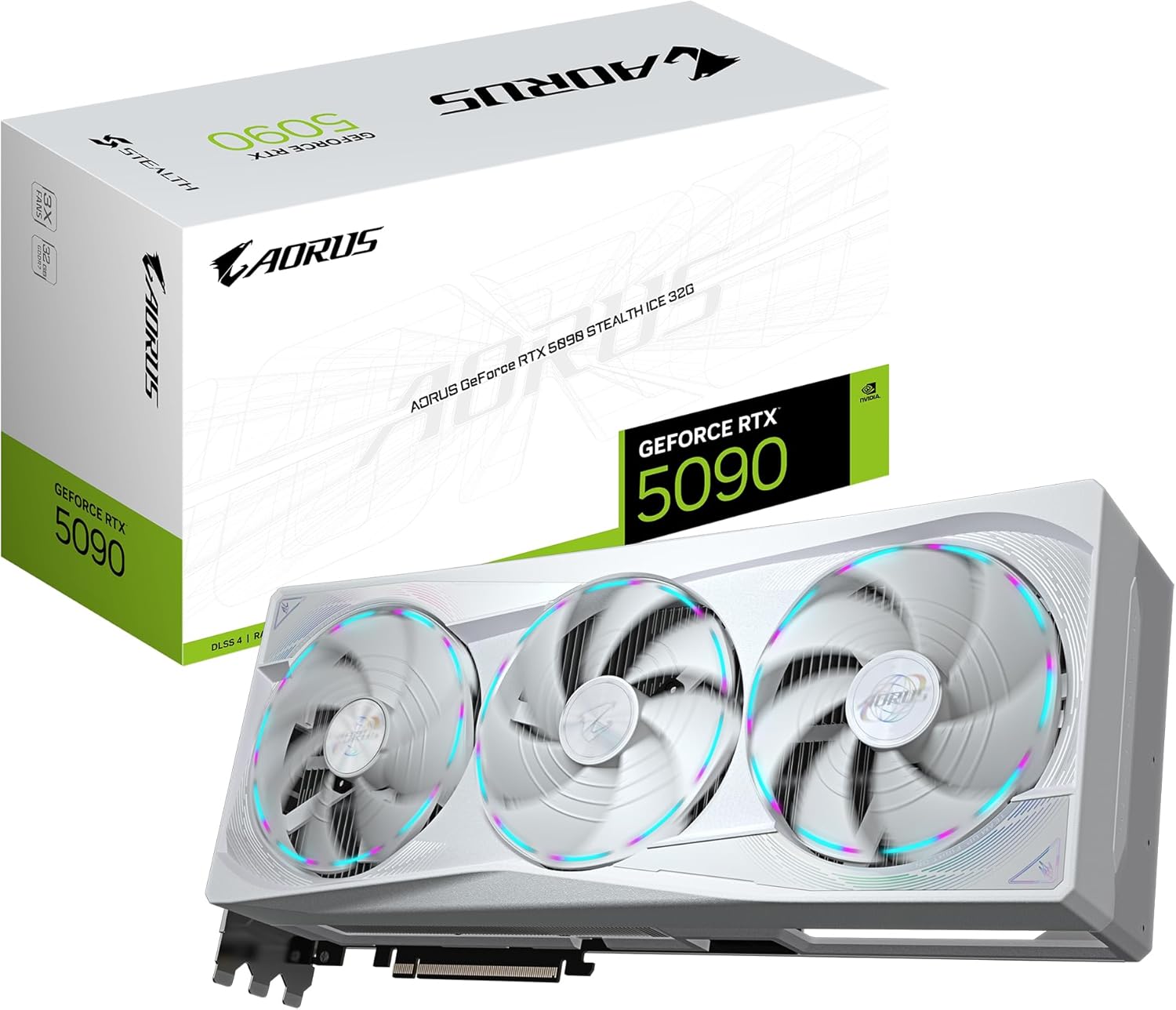
GigaByte GeForce RTX 5090 AORUS Stealth Ice
La GigaByte GeForce RTX 5090 AORUS Stealth Ice offre des performances exceptionnelles pour les joueurs de 4K avec ray tracing et DLSS 4. Son stockage de mémoire graphique GDDR7 de 32 Go assure une qualité d'image élevée. Cependant, sa forte consommation électrique et son température élevée sous charge peuvent être des inconvénients pour certains utilisateurs.
Les frais d'expédition si applicables, seront affichés au panier.
Prix mis à jour aujourd'hui • État : Neuf✓ Points forts
- Performances exceptionnelles pour les joueurs de 4K avec ray tracing
- Stockage de mémoire graphique GDDR7 de 32 Go
- DLSS 4 pour une qualité d'image et des performances améliorées
✗ Points faibles
- Forte consommation électrique
- Température élevée sous charge
Description détaillée
La GigaByte GeForce RTX 5090 AORUS Stealth Ice offre des performances exceptionnelles, idéale pour les joueurs de 4K avec ray tracing. Son stockage de mémoire graphique GDDR7 de 32 Go et DLSS 4 assurent une qualité d'image élevée. Cependant, sa forte consommation électrique et son température élevée sous charge peuvent être des inconvénients pour certains utilisateurs.
💡 Avis d'expert
Caractéristiques techniques
| Carte graphique gaming — Série | NVIDIA GeForce RTX 5090 |
|---|---|
| Carte graphique gaming — TDP | 600 watts |
| Carte graphique gaming — Dual Bios | non |
| Carte graphique gaming — Couleur | Blanc |
| Carte graphique gaming — Fabricant du chipset | NVIDIA |
| Carte graphique gaming — Nom de code du chipset | Blackwell |
| Carte graphique gaming — Série chipset | NVIDIA GB202 |
| Carte graphique gaming — Unité de processeur de flux | 21 760 |
| Carte graphique gaming — Raytracing Units | 170 |
| Carte graphique gaming — AI accelerators | 680 |
| Carte graphique gaming — Fréquence du chip de base | 2 017 MHz |
| Carte graphique gaming — Fréquence du chip boost | 2 655 MHz |
| Carte graphique gaming — Surfréquencé (overclock) | oui |
| Carte graphique gaming — Finesse de gravure | 5 nm |
| Carte graphique gaming — Cache L2 | 88 Mo |
| Carte graphique gaming — Fonctions du chipset | CUDA, AV1 Encoder, AV1 Decoder, NVIDIA Freestyle, NVIDIA Omniverse, NVIDIA ShadowPlay, NVIDIA Ansel, NVIDIA RTX Remix, Real-Time Ray Tracing, NVIDIA Reflex, NVIDIA Broadcast |
| Carte graphique gaming — Capacité de mémoire | 32 Go |
| Carte graphique gaming — Type de mémoire | GDDR7 |
| Carte graphique gaming — Interface de mémoire | 512 bits |
| Carte graphique gaming — Fréquence mémoire | 28 Go/s / 14 000 MHz |
| Carte graphique gaming — Bande passante | 1 792 Go/s |
| Carte graphique gaming — Emplacement | PCIe |
| Carte graphique gaming — Version PCIe | 5.0 |
| Carte graphique gaming — Voies PCIe | x16 |
| Carte graphique gaming — Port d'alimentation | 1 x 12V-2x6 (16 broches) |
| Carte graphique gaming — Height | 3,5 Slots |
| Carte graphique gaming — Longueur | 36 cm |
| Carte graphique gaming — Largeur | 15 cm |
| Carte graphique gaming — Low Profile | non |
| Carte graphique gaming — Connectique | 3x Display Port, HDMI |
| Carte graphique gaming — Spécification HDMI | HDMI 2.1 |
| Carte graphique gaming — Version DisplayPort | DisplayPort 2.1 |
| Carte graphique gaming — Résolution max. | 7680 x 4320 pixels |
| Carte graphique gaming — Nombre maximal de moniteurs | 4 |
| Carte graphique gaming — Nombre de ventilateurs | 3 |
| Carte graphique gaming — Couleur du ventilateur | Blanc |
| Carte graphique gaming — Propriétés du ventilateur | Éclairage RGB |
| Carte graphique gaming — Adapté pour | 4K, Ray tracing |
| Carte graphique gaming — Compatible DirectX | 12.2 |
| Carte graphique gaming — Support OpenGL | 4.6 |
| Carte graphique gaming — Modèle de Shader | 6.8 |
| Carte graphique gaming — Upscaling | DLSS |
| Carte graphique gaming — Synchronisation | G-Sync |
Questions fréquemment posées