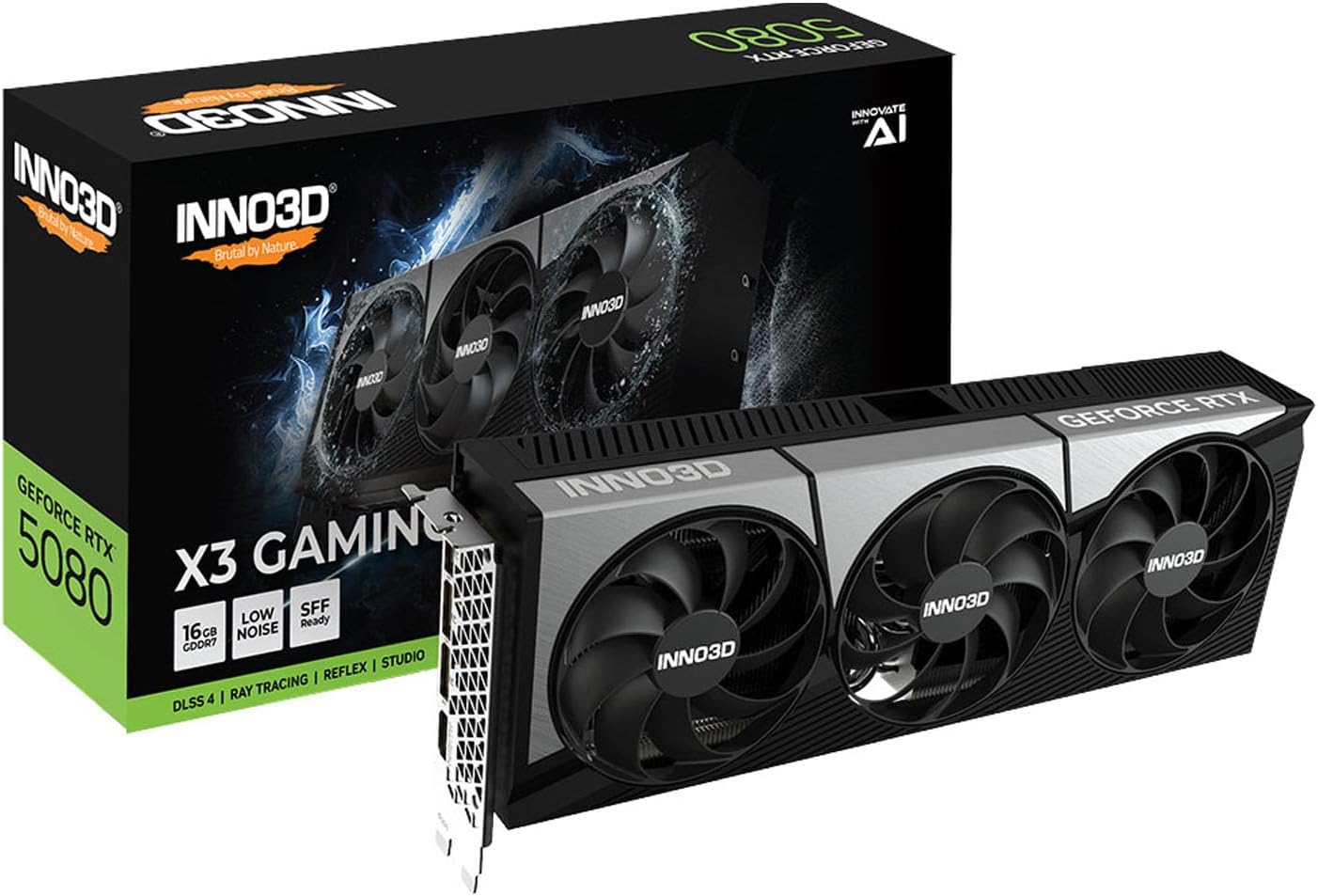
Inno3D GeForce RTX 5080 X3 Gaming OC
La Inno3D GeForce RTX 5080 X3 Gaming OC offre des performances exceptionnelles en 4K grâce à la technologie DLSS 4, tout en conservant une conception compacte pour les boîtes PC plus petites. Son refroidissement actif et ses ventilateurs Zero RPM contribuent à des températures de fonctionnement basses.
Les frais d'expédition si applicables, seront affichés au panier.
Prix mis à jour aujourd'hui • État : Neuf✓ Points forts
- Performances impressionnantes en 4K grâce à la technologie DLSS 4
- Conception compacte pour les boîtes PC plus petites
- Refroidissement actif et ventilateurs Zero RPM
✗ Points faibles
- Les ventilateurs peuvent devenir bruyants en charge élevée
- À peine plus rapide que la RTX 4080
Description détaillée
La Inno3D GeForce RTX 5080 X3 Gaming OC offre des performances exceptionnelles en 4K grâce à la technologie DLSS 4, tout en conservant une conception compacte pour les boîtes PC plus petites. Son refroidissement actif et ses ventilateurs Zero RPM contribuent à des températures de fonctionnement basses, mais attention : les ventilateurs peuvent devenir bruyants en charge élevée.
💡 Avis d'expert
Caractéristiques techniques
| Carte graphique gaming — Type de produit | Carte graphique gaming |
|---|---|
| Carte graphique gaming — Série | NVIDIA GeForce RTX 5080 |
| Carte graphique gaming — TDP | 360 watts |
| Carte graphique gaming — Dual Bios | non |
| Carte graphique gaming — Couleur | Noir |
| Carte graphique gaming — Fabricant du chipset | NVIDIA |
| Carte graphique gaming — Nom de code du chipset | Blackwell |
| Carte graphique gaming — Série chipset | NVIDIA GB203 |
| Carte graphique gaming — Unité de processeur de flux | 10 752 |
| Carte graphique gaming — Raytracing Units | 84 |
| Carte graphique gaming — AI accelerators | 336 |
| Carte graphique gaming — Fréquence du chip de base | 2 295 MHz |
| Carte graphique gaming — Fréquence du chip boost | 2 700 MHz |
| Carte graphique gaming — Surfréquencé (overclock) | oui |
| Carte graphique gaming — Finesse de gravure | 5 nm |
| Carte graphique gaming — Cache L2 | 64 Mo |
| Carte graphique gaming — Fonctions du chipset | CUDA, NVIDIA Freestyle, NVIDIA ShadowPlay, NVIDIA Omniverse, NVIDIA RTX Remix, NVIDIA Ansel, Real-Time Ray Tracing, NVIDIA Reflex |
| Carte graphique gaming — Capacité de mémoire | 16 Go |
| Carte graphique gaming — Type de mémoire | GDDR7 |
| Carte graphique gaming — Interface de mémoire | 256 bits |
| Carte graphique gaming — Fréquence mémoire | 30 Go/s / 15 000 MHz |
| Carte graphique gaming — Bande passante | 960 Go/s |
| Carte graphique gaming — Emplacement | PCIe |
| Carte graphique gaming — Version PCIe | 5.0 |
| Carte graphique gaming — Voies PCIe | x16 |
| Carte graphique gaming — Port d'alimentation | 1 x 12V-2x6 (16 broches) |
| Carte graphique gaming — Longueur | 30 cm |
| Carte graphique gaming — Largeur | 12 cm |
| Carte graphique gaming — Low Profile | non |
| Carte graphique gaming — Connectique | 3x Display Port, HDMI |
| Carte graphique gaming — Spécification HDMI | HDMI 2.1 |
| Carte graphique gaming — Version DisplayPort | DisplayPort 2.1 |
| Carte graphique gaming — Résolution max. | 7680 x 4320 pixels |
| Carte graphique gaming — Nombre maximal de moniteurs | 4 |
| Carte graphique gaming — Refroidissement | Actif |
| Carte graphique gaming — Nombre de ventilateurs | 3 |
| Carte graphique gaming — Couleur du ventilateur | Noir |
| Carte graphique gaming — Propriétés du ventilateur | Zero RPM, Flow Through |
| Carte graphique gaming — Adapté pour | 4K, Ray tracing |
| Carte graphique gaming — Compatible DirectX | 12.2 |
| Carte graphique gaming — Support OpenGL | 4.6 |
| Carte graphique gaming — Modèle de Shader | 6.8 |
| Carte graphique gaming — Upscaling | DLSS |
| Carte graphique gaming — Synchronisation | G-Sync |
Questions fréquemment posées