Face-à-Face Technique
Méthode de calcul
ASUS ProArt GeForce RTX 5080 16GB OC Edition GDDR7 Carte Graphique NVIDIA Blackwell DLSS 4 PCIe 5.0 USB Type-C HDMI 2.1b DisplayPort 2.1b PROART-RTX5080-O16G vs Microsoft Surface Pro (Chargeur Non Inclus) | Copilot+ PC | Ecran Tactile OLED 13” | Snapdragon® X Elite | 16Go RAM | SSD 1To | Dernier Modèle, 11ème Edition | Noir | Ecran Tactile OLED 13" | Copilot+ PC | Noir | Windows 11 Home | 11e édition
Analyse comparative des caractéristiques réelles, confrontation des points forts et verdict technique.
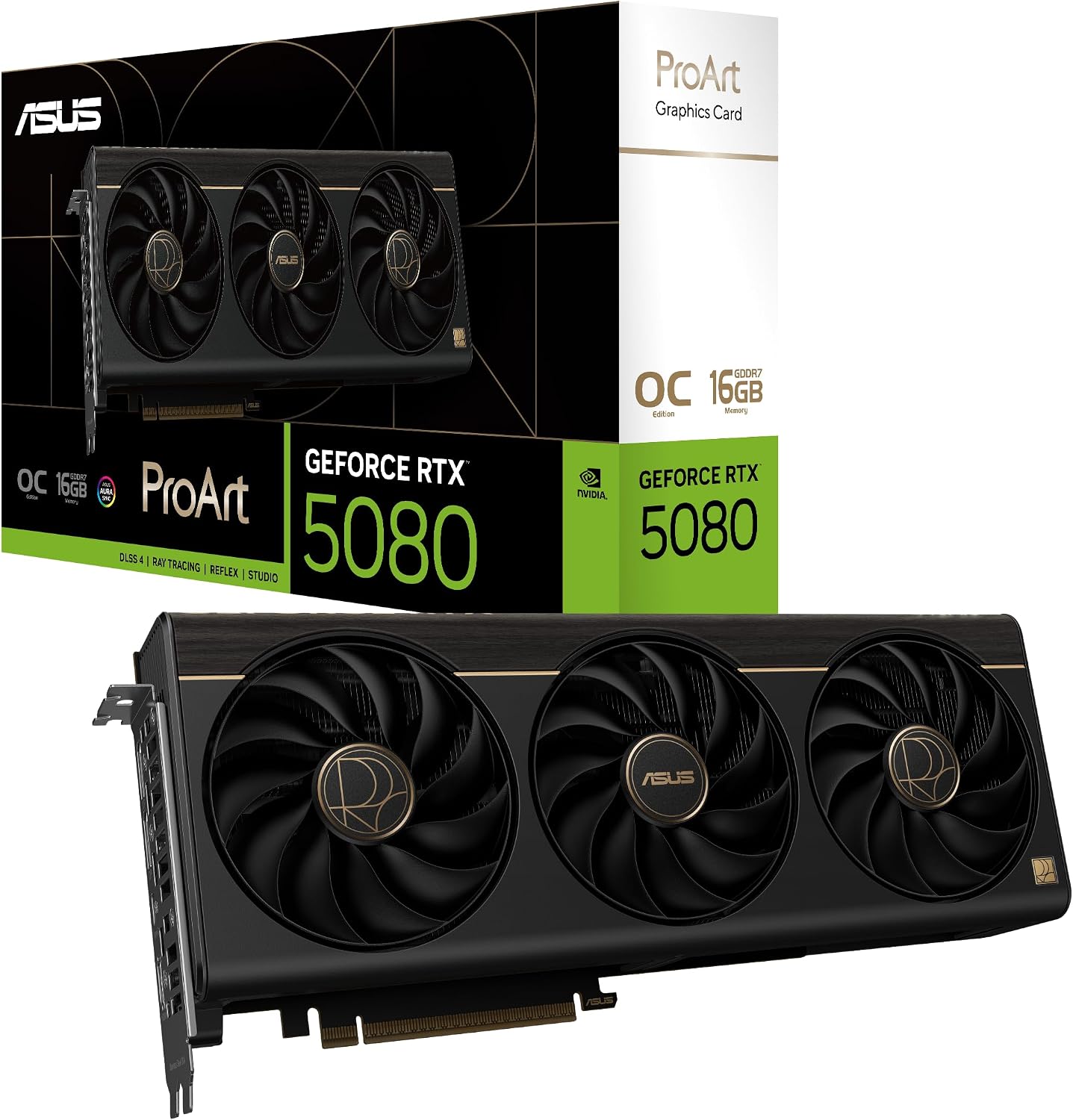
ASUS ProArt GeForce RTX 5080 16GB OC Edition GDDR7 Carte Graphique NVIDIA Blackwell DLSS 4 PCIe 5.0 USB Type-C HDMI 2.1b DisplayPort 2.1b PROART-RTX5080-O16G
SCORE GLOBAL
Complétude : 100/100
PRIX INDICATIF
1 979,78 €

Microsoft Surface Pro (Chargeur Non Inclus) | Copilot+ PC | Ecran Tactile OLED 13” | Snapdragon® X Elite | 16Go RAM | SSD 1To | Dernier Modèle, 11ème Edition | Noir | Ecran Tactile OLED 13" | Copilot+ PC | Noir | Windows 11 Home | 11e édition
SCORE GLOBAL
Complétude : 100/100
PRIX INDICATIF
1 599,99 €
Bilan : ASUS ProArt GeForce RTX 5080 16G...
Points forts
- 16 Go de mémoire GDDR7 pour des projets 4K/8K sans compromis.
- Support complet du ray tracing et du DLSS pour une expérience immersive.
- Refroidissement actif avec 3 ventilateurs ASUS Axial-tech pour une dissipation efficace.
- Connectique complète (HDMI 2.1, DisplayPort 2.1) pour jusqu’à 4 moniteurs.
Points faibles
- Consommation élevée (jusqu’à 360W) exige une alimentation de 1600W minimum.
- Son bruit en charge maximale, malgré le design silencieux en mode Zero RPM.
Bilan : Microsoft Surface Pro (Chargeur...
Points forts
- Écran OLED 13 pouces 120Hz avec contraste exceptionnel et format 3:2 optimal pour la lecture et les notes.
- Processeur Snapdragon X Elite 12 cœurs à 3,4 GHz, offrant des performances fluides pour les tâches bureautiques et les applications Windows.
- Autonomie de 10h, avec charge rapide et ports USB-C Thunderbolt 4 pour une connectivité ultra-rapide et polyvalente.
Points faibles
- Performances graphiques limitées, ce qui le rend inadapté aux jeux vidéo ou aux applications lourdes.
- Prix élevé pour une configuration de base, avec des accessoires comme le clavier Type Cover qui augmentent le coût total.
Spécifications Directement Comparables
Critères mesurables présents sur les deux fiches produits.
| Critère | ASUS ProArt GeForce RTX 5080 16GB OC Edition GDDR7 Carte Graphique NVIDIA Blackwell DLSS 4 PCIe 5.0 USB Type-C HDMI 2.1b DisplayPort 2.1b PROART-RTX5080-O16G | Microsoft Surface Pro (Chargeur Non Inclus) | Copilot+ PC | Ecran Tactile OLED 13” | Snapdragon® X Elite | 16Go RAM | SSD 1To | Dernier Modèle, 11ème Edition | Noir | Ecran Tactile OLED 13" | Copilot+ PC | Noir | Windows 11 Home | 11e édition |
|---|---|---|
| Marque | ASUS | Microsoft |
| Catégorie | Informatique > Composants et pièces de remplacement > Composants internes > Cartes graphiques | Informatique > Tablettes tactiles |
| Couleur | Noir | Noir |
| Asin |
B09CL8ZFJ5
|
B0DQTYV8Q6
|
| Connectiques | USB Type-C, HDMI 2.1b, DisplayPort 2.1b | USB-C Thunderbolt 4 |
| Poids | Non spécifié | 1,2 kg |
| Modèle |
PROART-RTX5080-O16G
|
Surface Pro 11
|
Équipements & Fonctionnalités Propres
Éléments spécifiques déclarés par chaque constructeur.
ASUS ProArt GeForce RTX 5080 16GB OC Edition GDDR7 Carte Graphique NVIDIA Blackwell DLSS 4 PCIe 5.0 USB Type-C HDMI 2.1b DisplayPort 2.1b PROART-RTX5080-O16G
Titre
ASUS ProArt GeForce RTX 5080 16GB OC Edition GDDR7 Carte Graphique NVIDIA Blackwell DLSS 4 PCIe 5.0 USB Type-C HDMI 2.1b DisplayPort 2.1b PROART-RTX5080-O16G
Mémoire
16 Go GDDR7
Bandepassantememoire
960 Go/s
Chipset
NVIDIA Blackwell
Technologiedlss
DLSS 4
Technologieraytracing
Ray Tracing
Technologiereflex
NVIDIA Reflex 2
Technologieace
NVIDIA ACE
Technologieencoder
Ninth-gen NVIDIA Encoder
Technologiebroadcast
NVIDIA Broadcast
Interfacepcie
PCIe 5.0
Fréquencebase
2295 MHz
Fréquenceboost
2730 MHz
Tdp
360 W
Alimentationminimum
1600 W
Refroidissement
3 ventilateurs ASUS Axial-tech
Systèmerefroidissement
Phase-Change GPU Thermal Pad, Vapor Chamber
Technologieai
Fifth-Gen Tensor Cores, New Streaming Multiprocessors, Fourth-Gen Ray Tracing Cores
Logicielsinclus
GPU Tweak III, MuseTree
Compatibilitéos
Windows 11 Home, Windows 11 Pro
Utilisation
Créateurs et gamers exigeants
Design
Compact
Finition
Noir
Dimensions
Non spécifié
Garantie
Non spécifié
Supporttechnique
Non spécifié
Prix
Non spécifié
Datesortie
2026
Version
OC Edition
Typemémoire
GDDR7
Architecture
Blackwell
Niveauperformance
Haut de gamme
Applications
Création numérique, Jeux exigeants, 4K/8K
Compatibilitéalimentation
ASUS Prime 850W Gold / TUF Gaming 850W Gold
Compatibilitéformefacteur
SFF-Ready (2.5 Slot Design)
Connectiqueusbtypec
USB Type-C Port
Connectiquehdmi
HDMI 2.1b
Connectiquedisplayport
DisplayPort 2.1b
Technologieneuralrendering
Neural Rendering
Technologiedigitalhumans
Digital Humans
Technologieaiassistant
AI Assistants
Technologieneuralshaders
Neural Shaders
Technologieframewarp
Frame Warp
Technologiemultiframegeneration
Multi Frame Generation
Technologienvidiacreatortools
NVIDIA Studio creator tools and technology
Technologienvidiabroadcast
NVIDIA Broadcast
Technologienvidiacoder
Ninth-gen NVIDIA Encoder
Technologienvidiacreator
NVIDIA ACE
Microsoft Surface Pro (Chargeur Non Inclus) | Copilot+ PC | Ecran Tactile OLED 13” | Snapdragon® X Elite | 16Go RAM | SSD 1To | Dernier Modèle, 11ème Edition | Noir | Ecran Tactile OLED 13" | Copilot+ PC | Noir | Windows 11 Home | 11e édition
Édition
11ème Edition
Système D'exploitation
Windows 11 Home
Processeur
Snapdragon® X Elite
Ram
16 Go
Stockage
1 To SSD
Écran
13 pouces
Type D'écran
OLED
Résolution Écran
2880 x 1920 pixels
Fréquence De Rafraîchissement Écran
120 Hz
Autonomie Batterie
10 heures
Chargeur Inclus
Non
Ia Intégrée
Copilot+ PC
Usage Recommandé
Professionnels nomades, étudiants, créatifs exigeants
Type De Produit
2-en-1 hybride
Gpu
Snapdragon Adreno X Elite
Compatibilité Gaming
Non conçu pour le gaming ou les applications graphiques lourdes
Fonctionnalités
Écran tactile multi-touch, Format détachable, Charge rapide via USB-C Thunderbolt 4